
How Does the Amazon FBA Reimbursement Process Work in 2026?
Table of Contents
Introduction
For many internet merchants, selling through Fulfilment by Amazon FBA seems like a dream come true because your products are sent to Amazon’s warehouses, where they take care of storage, packing, shipping, and even customer service. Most new sellers are first unaware, though, that errors persist even when Amazon controls logistics. Items can be wrongly reimbursed, lost, damaged, or miscounted. Sellers wanting to protect their profits will have to understand how to apply the Amazon FBA refund mechanism in 2026.
FBA compensation is Amazon’s method of making you right should something go wrong on their end, in essence. You could be able to recover funds if a unit disappears within a fulfilment centre, you are charged improperly, or a client is refunded but never returns the merchandise. The catch is that payments sometimes do not happen automatically; thus, you may lose money without even realising it if you’re unsure of what to confirm or how to file a claim.
This topic has been trending heavily among e-commerce creators and seller communities lately because Amazon has introduced policy updates and automation changes that directly affect reimbursements. Many sellers in 2026 are discovering that relying only on Amazon’s system isn’t enough; they need to audit their accounts regularly or use an Amazon FBA reimbursement service to track discrepancies. That’s why search interest around terms like best Amazon reimbursement service and Amazon FBA refund reimbursement has grown rapidly.
Think of it this way: running an FBA business is like running a digital warehouse partnership. Amazon controls the processes; nevertheless, you must still review the figures. Understanding reimbursements enables you to quickly recover losses, identify mistakes early, and maintain the financial health of your company. And really, knowing where to look and what to assert rather than complex is all there is to be learned once you grasp the procedure.
In this guide, we’ll break down exactly how the Amazon FBA reimbursement process works in 2026, what’s changed recently, when you qualify, and how you can make sure no eligible reimbursement slips through the cracks. Whether you’re a beginner seller, a side hustler, or scaling your brand full-time, this is one system you’ll definitely want to master.
What are Amazon FBA Reimbursements?

Amazon FBA reimbursement is the money Amazon pays sellers when something goes wrong while their fulfilment system is handling your products. In simple terms, it’s a financial correction issued when errors occur, like lost inventory, damaged items, or incorrect fees.
With Fulfilment by Amazon (FBA), Amazon handles returns, packing, warehousing, and shipping. Though this simplifies sales, errors may still occur. A package could disappear in a warehouse, an item may get damaged during handling, or a customer may get a refund without physically returning the goods. Should any of these events cause you monetary loss, Amazon could reimburse you by reimbursement.
Why Do Sellers Need Amazon FBA Refund Reimbursements?
Because lost money is far more common than most sellers think. Many sellers assume that if something goes wrong inside the fulfilment system, it will automatically be corrected. But in reality, a noticeable percentage of revenue can quietly slip through the cracks if reimbursements aren’t tracked and claimed. According to industry estimates, lost reimbursement chances may result in 1%–3% of a seller’s annual revenue going unclaimed. The actual monetary value can be shockingly high, even though that percentage may seem low.
To understand the impact, consider this:
Annual Revenue | Potential Loss |
$100,000 | $1,000–$3,000 |
$1M | $10,000–$30,000 |
For most businesses, that’s not pocket change; it’s profit that could have been reinvested into inventory, ads, or growth.
So why do sellers miss out on reimbursements?
The reasons are usually simple but costly. Many sellers don’t regularly audit their reports, some aren’t aware of claim deadlines, others misunderstand Amazon’s reimbursement policies, and a large number assume Amazon automatically corrects every mistake.
The truth is, it doesn’t always happen on its own.
That’s exactly why understanding FBA reimbursements is essential. Sellers who actively monitor discrepancies and file claims when needed are far more likely to protect their revenue and avoid hidden losses that build up over time.
What Changed in Amazon’s 2025-2026 Reimbursement Policy?

One of the most crucial upgrades that sellers must comprehend is this one. Amazon revealed a significant change to the formula used to determine FBA payments in late 2024. In the past, merchants received reimbursement based on the selling price less fees when inventory was lost or destroyed. However, under the revised regulation, the manufacturing (or sourcing) cost of the product is now used to determine compensation.
Before:
Reimbursement = Selling price – fees
Now:
Reimbursement = Manufacturing cost estimate (or seller-provided cost data)
Though it had said the updated compensation system would begin on March 10, 2025, Amazon rescheduled its launch to March 31, 2025, providing suppliers more time to submit sourcing cost information and amend their accounts.
The cost of manufacturing, under the revised criteria, is the total of payments made to acquire or produce a good from a producer, wholesaler, or supplier. It omits processing, shipping, customs, and other related expenses, which can significantly reduce the amount of the refund.
Why This Change Matters for Sellers
This policy shift directly impacts how much money sellers recover when inventory issues occur.
Key implications include:
- Lower payouts: reimbursements may be smaller than before because they’re based on cost, not retail price
- Documentation matters: sellers may need invoices or proof of sourcing costs
- Accuracy is critical: if you don’t provide your own cost data, Amazon may estimate it using comparable products
In short, understanding the reimbursement system is no longer optional; it’s essential. Sellers who don’t track their costs or verify reimbursements risk leaving significant money on the table under the new policy.
What are the Types of Amazon FBA Reimbursement Claims?
For a great spectrum of problems that happen while inventory is processed inside the fulfilment network, Amazon 1P Vendor accounts may be eligible for reimbursement from Amazon.
Inventory-Related Issues
These are the most common reimbursement cases and usually occur while products are stored or handled inside fulfilment centres. Examples include:
- Lost items that disappear during storage or transfer
- Damaged inventory caused by warehouse handling
- Units destroyed by Amazon without proper justification
- Inbound shipment discrepancies where the sent quantities don’t match the received stock
Customer-Related Issues
Sometimes reimbursements are triggered by problems during the return or refund process. Sellers may qualify when:
- A refund is issued, but the customer never returns the item
- A returned item is received, but the refund amount is incorrect
- A replacement is sent without the original product being returned
Fee-Related Errors
Not all reimbursement claims involve physical inventory. Some relate to incorrect charges applied to your account, such as:
- Wrong weight-based fulfilment fees
- Incorrect product dimensions were recorded in the system
- Duplicate or double-charged fees
Amazon’s reimbursement policy governs all of these situations and specifies which cases qualify, as well as the conditions to be met before payout is authorised. Understanding these categories helps vendors to evaluate their accounts, identify mistakes, and retrieve funds otherwise ignored.
How the Amazon FBA Reimbursement Process Works?
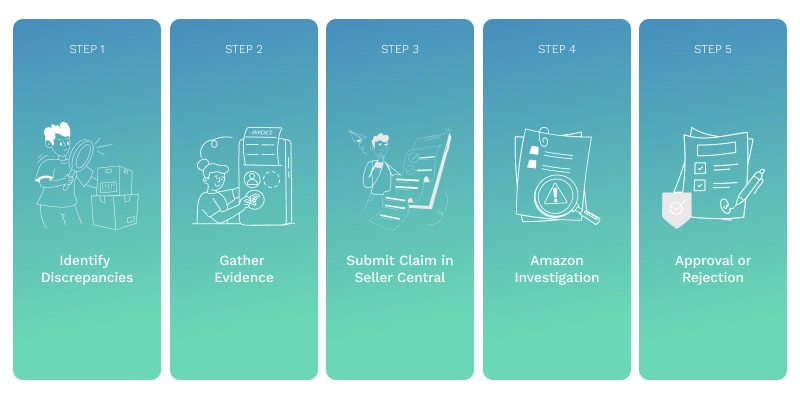
Though the reimbursement claim procedure seems easy, it actually demands meticulous monitoring, exact paperwork, and prompt action. Far more likely to recover lost money are those sellers who grasp every stage.
Step 1: Identify Discrepancies
The procedure starts with the examination of financial records and inventory. Spot problems like missing units, damaged items, unexpected refunds, or erroneous charges by often reviewing your data. Many sellers miss reimbursements simply because they never check these reports closely.
Step 2: Gather Evidence
Once you detect a variance, the next move is gather supporting evidence. This paper improves approval chances and supports your case. Useful evidence may include:
- Supplier invoices
- Shipment and tracking records
- Manufacturing or sourcing cost breakdowns
- Return confirmations or customer return data
The more accurate and organised your documents are, the smoother your claim process will be.
Step 3: Submit Claim in Seller Central
After preparing your evidence, you must submit the claim through Seller Central. This calls for a comprehensive analysis of the issue together with all supporting evidence. Incomplete or ambiguous submissions frequently cause delays or rejections.
Step 4: Amazon Investigation
Once submitted, Amazon reviews your request internally. Their team checks warehouse logs, shipping scans, fulfilment data, and account records to verify whether the discrepancy actually occurred.
Step 5: Approval or Rejection
After the investigation, Amazon makes a decision:
- If approved → reimbursement is issued to your account
- If rejected → you can appeal by submitting additional supporting evidence
Understanding this step-by-step process helps sellers stay proactive, organised, and prepared, making it much easier to recover money that might otherwise be lost.
What Reports Should Sellers Check?
Sellers must regularly examine the appropriate dashboard reports to find reimbursement opportunities. These reports include the information that uncovers possible losses, errors, and inconsistencies that may otherwise go unreported.
Here are the key reports every seller should monitor:
- Inventory Adjustment Report – Displays any modifications to your stock, including pieces that have been lost, damaged, or found.
- Received Inventory Report – Confirms quantities Amazon received compared to what you shipped.
- Removal Order Report – Tracks items removed or disposed of from fulfilment centres.
- Reimbursement Report – Lists reimbursements Amazon has already issued (so you can verify accuracy).
- Returns Report – Displays return activity, including refunds and replacement cases.
Regular auditing is vital since claims for payment have to be filed within particular time frames. Your odds of successfully filing a claim and recovering money rise with the early identification of conflicts. Sellers who regularly examine these reports keep ahead of mistakes instead of finding losses many months later.
What are the Documents Required for Claims?
Particularly under the revised compensation guidelines, Amazon now demands more rigorous and accurate documentation than it used to. Proper documentation confirms a real financial loss and validates your claim by demonstrating the inventory’s value.
The following are a few of the most often needed documents:
- Supplier invoices: must clearly display the supplier’s business name and product details
- Cost breakdowns: showing manufacturing or sourcing costs per unit
- Proof of ownership: such as purchase records or order confirmations
- Shipping confirmations: including tracking IDs and delivery verification
Among these, invoices play a particularly important role because they validate the product’s cost and establish the monetary value tied to the claim. Amazon may calculate the cost without them, resulting in a lower refund amount.
The review process will go more quickly and smoothly if documents are arranged, corrected, and made easily accessible. Keeping correct records facilitates vendor approval and expedites reimbursements with fewer holdups
What are the Deadlines for Filing Claims?
Though in most situations vendors have to file their claim within eighteen months from the date of the occurrence, deadlines for reimbursement claims vary depending on the kind of problem. Lost goods, broken products, or fulfilment errors are among the many typical scenarios to which this time limit applies.
Usually, missing the deadline means losing permanently the chance to be refunded. Generally, Amazon does not reactivate terminated cases, so any undetected inconsistency may become unrecoverable income.
That’s why timing is critical. Early tracking of problems and frequent review of reports improve sellers’ chances of making claims within the permissible window. Many companies are now using automated tracking solutions that constantly analyse reports, find mistakes, and alert them before deadlines expire, since manually checking everything can be challenging, especially for high-volume vendors.
Knowing the deadlines and acting fast will therefore protect your earnings; it is not just helpful.
How Amazon Calculates Reimbursement Amounts?
Amazon does not employ a set formula to determine the amount of compensation payable to a seller. Rather, it evaluates multiple elements to determine a fair pay amount depending on the unique conditions and product properties.
Key elements Amazon considers include:
- Fair market value — the typical selling price of the item in the marketplace.
- Item condition — whether the product was new, used, or customer-damaged.
- Sourcing or manufacturing cost, especially under the updated reimbursement rules.
- Applicable fees — such as fulfilment or referral fees that may affect calculations.
Amazon’s support instructions specify that reimbursements are occasionally computed as a percentage of the item’s assessed fair market value, less any applicable charges, especially when enough cost proof is lacking.
But, Amazon today more typically uses cost-based reimbursement methods than retail sales prices following the 2025 policy review. This implies your pay may be based on your cost to get or create the item rather than on what you would have made selling it.
This change makes it more crucial than before to keep precise cost information. Sellers that give exact sourcing information are more likely to be fairly and exactly paid rather than estimated payments.
What’s The Difference Between Manual and Automated Claims?
Sellers usually have to choose between using automated solutions and manually submitting reimbursement requests. Both approaches could work; your company’s size, inventory level, and available time for report analysis will help you to decide which is most appropriate.
The following is a thorough comparison to enable you grasp the performance of every strategy in practical selling contexts:
Factor | Manual Claims | Automated Tools |
Speed | Time-consuming process that requires checking reports one by one | Much faster since systems scan reports instantly |
Accuracy | Higher chance of human error or missed discrepancies | Algorithm-based detection reduces mistakes |
Monitoring | Requires constant manual tracking and regular logins | Runs continuously in the background |
Scalability | Difficult to manage as order volume increases | Easily handles large inventories and high sales volume |
Consistency | Depends on seller’s schedule and discipline | Works 24/7 without interruption |
Claim Detection | Limited to what the seller notices | Identifies hidden or complex discrepancies |
Effort Required | High effort and attention to detail | Minimal manual effort once set up |
Best For | Small sellers with low inventory turnover | Medium to large sellers or scaling businesses |
Smaller sellers who handle limited inventory and prefer complete control over every claim can find manual filing to be very useful still. But as operations expand, manually tracking discrepancies gets very labour-intensive and challenging.
Many high-volume merchants, therefore, finally turn to automated solutions. Particularly helpful for companies seeking efficiency, accuracy, and scalability, these technologies constantly monitor reports, identify problems quickly, and guarantee that qualified reimbursements are not missed.
What are the Common Reasons Why Claims Get Rejected?
Not every reimbursement request gets approved; knowing why claims fail helps sellers avoid needless delays or losses. Rejections often result from something missing, wrong, or presented wrongly rather than from the claim being invalid.
Here are the most common reasons reimbursement claims get rejected:
- Missing documentation: required proof, such as invoices or shipment records, wasn’t provided
- Deadline expired: the claim was filed after the allowed time window
- Incorrect category selected: the issue type chosen didn’t match the actual problem
- Insufficient evidence: the documents submitted didn’t clearly support the claim
- Duplicate submission: the same issue was reported more than once
Most rejections come from incomplete or incorrect information rather than from the seller’s view on the topic. This implies many rejected claims can actually be fixed and resubmitted if you provide stronger supporting data or correct the original mistake.
Sellers who thoroughly examine the standards, double-check information, and supply thorough paperwork substantially raise their prospects of acceptance and save time on avoidable rejections.
What are the Hidden Mistakes Sellers Make?
Even experienced sellers can lose money through small oversights that seem harmless at first but gradually add up into significant losses. Reimbursement opportunities often slip through the cracks not because they don’t exist but because they go unnoticed or untracked.
Here are some common hidden mistakes sellers make:
- Not checking reports weekly: irregular monitoring makes it easy to miss discrepancies within claim windows.
- Ignoring small discrepancies: minor losses may seem insignificant individually but can accumulate into large amounts over time.
- Relying entirely on Amazon’s automation: assuming every issue is automatically detected and corrected can lead to missed reimbursements.
- Forgetting deadlines: waiting too long to review reports may cause claims to expire.
- Not saving invoices: missing documentation can prevent approval even when the claim is valid.
Surprisingly, these errors are frequently made, particularly by busy sellers who prioritise sales development above backend audits. However, when made repeatedly over hundreds or thousands of orders, little mistakes can result in significant financial losses.
In short, small mistakes don’t stay small, they compound. Sellers who build consistent auditing habits and maintain organised records are far more likely to catch issues early and recover money that might otherwise be lost.
Why Consult Amazon FBA Reimbursement Services like ValueBack.AI?
Many sellers lose money not because reimbursements aren’t available, but because they don’t have time to track, document, and file claims correctly. Reimbursement services exist to solve this problem by automatically monitoring your account, detecting discrepancies, and submitting claims on your behalf.
By analyzing reports for missing inventory, fee mistakes, damaged goods, and refund problems, platforms like ValueBack.ai enable sellers to get back funds. The system runs automatically in the background, finds qualifying cases, creates documentation, and handles submissions so you keep complete control of your seller account instead of manually checking data.
Especially helpful are these services following recent policy changes that call for greater documentation and cost-based compensation calculations. Stricter deadlines and regulations help professional tools increase approval prospects and lower missed claims.
In simple terms: reimbursement services don’t earn you new money they recover the money you’re already owed but might never claim on your own.
Overlooked Amazon FBA reimbursements draining profits?
Expert audit recovers every penny.
Conclusion
For sellers, knowing the mechanism of the FBA compensation procedure is no longer discretionary; it is rather essential to safeguard your profits. From missing goods and damaged stock to incorrect fees and return errors, modest variations may eat away at your profit margins silently. Sellers who often go over reports, preserve correct records, and meet claim deadlines have a considerably greater chance of getting their rightful compensation back.
Recent regulatory adjustments shifting reimbursements toward cost-based calculations and more rigorous documentation standards elevate precision and organisation above their previous significance. Whether you handle claims manually or utilise automated tools, remaining proactive is the secret to avoiding missed opportunities.
In the end, reimbursements aren’t just about fixing errors; they’re about maximising profitability. Sellers who treat reimbursement tracking as part of their business strategy gain a financial advantage, while those who ignore it risk leaving significant money behind.
FAQ’s
- Do all sellers qualify for FBA reimbursements?
A. Yes, any seller usingFulfillment by Amazon can qualify if an eligible issue occurs, such as lost inventory, damaged items, or incorrect fees. Eligibility depends on meeting claim conditions and deadlines.
- How long does Amazon take to process reimbursement claims?
A.Processing times vary, but most claims are reviewed within a few days to a few weeks depending on complexity and documentation quality.
- Can I file a claim without invoices?
A.You can try, but approval chances are lower. Without invoices or cost proof, reimbursement amounts may be estimated or the claim may be rejected.
- Are reimbursements automatic?
A.Not always. Some discrepancies are corrected automatically, but many require sellers to detect the issue and submit a claim manually.
- Is it better to use an automated reimbursement tool?
A.For high-volume sellers, yes. Automation helps detect hidden discrepancies, track deadlines, and submit claims faster than manual monitoring.