Selling online today isn’t just about listing products and watching orders roll in; it’s about protecting every rupee of profit you earn. And if you’re using Walmart Fulfilment Services (WFS), you already know how powerful it can be. It handles storage, packing, shipping, returns, and customer service, making scaling your ecommerce business feel almost effortless. But here’s the catch, most sellers don’t realise until it’s too late: automation doesn’t mean perfection.
Behind the scenes, even advanced fulfilment systems can make small mistakes. A shipment might be received with fewer units than you sent. A return could be processed incorrectly. Fees may be calculated using the wrong product dimensions. Individually, these issues look tiny, almost harmless. But over time, they quietly stack up and chip away at your margins. That’s exactly why smart sellers are now turning to Walmart seller reimbursement service strategies and audit systems to track down lost revenue.
This is where a smart Walmart WFS audit becomes a game-changer. Rather than making assumptions about lost profits, auditing provides data-driven clarity. It assists you in spotting anomalies, correctly filing claims, and recovering money that rightfully is yours. To make sure that all transactions, fees, and inventory movements add up appropriately, think of it as a financial health check for your seller account.
Many sellers assume Walmart automatically reimburses all fulfilment errors. In reality, reimbursement eligibility often depends on whether the seller identifies the issue and submits a claim within the required timeframe. That means if you’re not reviewing your reports regularly, you could be leaving money on the table without even knowing it.
For Gen Z entrepreneurs and modern ecommerce brands who value efficiency, automation, and transparency, auditing isn’t just an accounting task; it’s a profit strategy. With competition growing fast on marketplaces and margins getting tighter, recovering overlooked revenue can make a real difference in scaling sustainably.
In this guide, we’ll break down everything you need to know about WFS Walmart auditing, how it works, why it matters, what errors to look for, and how smart auditing systems can help you reclaim lost profits without drowning in spreadsheets. By the end, you’ll know exactly whether your business is missing hidden earnings and how to get them back.
FBA compensation is Amazon’s method of making you right should something go wrong on their end, in essence. You could be able to recover funds if a unit disappears within a fulfilment centre, you are charged improperly, or a client is refunded but never returns the merchandise. The catch is that payments sometimes do not happen automatically; thus, you may lose money without even realising it if you’re unsure of what to confirm or how to file a claim.
This topic has been trending heavily among e-commerce creators and seller communities lately because Amazon has introduced policy updates and automation changes that directly affect reimbursements. Many sellers in 2026 are discovering that relying only on Amazon’s system isn’t enough; they need to audit their accounts regularly or use an Amazon FBA reimbursement service to track discrepancies. That’s why search interest around terms like best Amazon reimbursement service and Amazon FBA refund reimbursement has grown rapidly.
Think of it this way: running an FBA business is like running a digital warehouse partnership. Amazon controls the processes; nevertheless, you must still review the figures. Understanding reimbursements enables you to quickly recover losses, identify mistakes early, and maintain the financial health of your company. And really, knowing where to look and what to assert rather than complex is all there is to be learned once you grasp the procedure.
In this guide, we’ll break down exactly how the Amazon FBA reimbursement process works in 2026, what’s changed recently, when you qualify, and how you can make sure no eligible reimbursement slips through the cracks. Whether you’re a beginner seller, a side hustler, or scaling your brand full-time, this is one system you’ll definitely want to master.
Missing Walmart WFS profits?
Expert audit unlocks hidden revenue.
What is Walmart WFS Auditing and Why Does It Matter?
Let’s put it simply this way: The process of checking your seller account data, including inventory, fees, returns, reimbursements, and payments, to ensure that all the numbers add up correctly, is known as Walmart WFS auditing. Consider it similar to reviewing your bank statement following a hectic buying trip.
I assume you want to confirm that you were not billed for an item that you did not purchase. The same reasoning holds here, but you can lose hundreds or even thousands of dollars without even noticing it, rather than a few additional fees.
Walmart Fulfilment Services relieves you of logistical chores; Walmart stores your products, ships orders, handles returns, and even offers customer service. Sellers save a great deal of time and find great ease. But because the system operates at a massive scale, small operational errors can happen. Packages might vanish, products may be ruined in a warehouse, or fees may be miscalculated because of wrong weight or dimensions. These issues could appear little by themselves. All of them combined can stealthily deplete your earnings.
That’s exactly where a smart audit comes in.
- A proper WFS Walmart audit reviews backend reports and transaction logs to detect discrepancies such as:
- Missing or lost inventory.
- Incorrect fulfilment or storage fees.
- Customer refunds that shouldn’t have been issued.
- Returned items are not added back to stock.
- Reimbursement amounts that were underpaid or never issued.
This is important because Walmart does not always automatically pay for every qualifying issue. Many times, sellers have to find inconsistencies on their own and file claims within a set time frame. windows. Missing those windows might result in permanent loss of money justly due. That’s why many growing brands now rely on a Walmart seller reimbursement service or automated auditing tools to monitor accounts continuously.
For modern e-commerce sellers, especially fast-scaling brands, auditing isn’t just a technical task. It’s a profit-protection strategy. Gen Z entrepreneurs, side-hustlers, and digital-first business owners are particularly quick to understand this because they treat data like gold. They know that tracking performance metrics isn’t optional; it’s how you stay competitive.
Think of auditing as your business’s financial radar system. You are flying blind without it. You may find problems early, repair them quickly, and reclaim income before it vanishes for good.
How Walmart Fulfilment Services (WFS) Works for Sellers?
When you enrol in Walmart WFS, you ship your inventory in bulk to Walmart’s fulfilment centres. After your purchases arrive, Walmart stores them safely in its warehouse system. Every time a customer makes a purchase, Walmart handles all back-end operations, including item selection, precise packaging, delivery, and delivery tracking. They also handle returns and consumer service questions. In essence, Walmart transforms into your logistical crew.
This is a significant win for sellers, particularly Gen Z founders and modern e-commerce entrepreneurs managing several projects. Without having to hire employees or manage warehouses, you may immediately use a top-notch fulfilment infrastructure. It’s similar to upgrading from a bicycle to a bullet train without having to construct the tracks yourself.
The Step-by-Step Flow of WFS Walmart Operations:
To understand why auditing matters later, you first need to see how the system runs:
- Inventory Shipment:You send products to Walmart’s designated fulfilment centres. These shipments are logged and checked when received.
- Storage & Tracking:Your items are stored and tracked digitally inside Walmart’s system. Stock levels update automatically when orders are placed.
- Order Processing:Walmart chooses and packs your product from its warehouse when a customer makes a purchase.
- Orders are sent using Walmart’slogisticsnetwork, sometimes with quick delivery options that enhance the competitiveness of your listing.
- Walmart assesses returned goods and decides whether they should be labelled destroyed or eligible for restocking.
Every stage is run automatically and system-driven; although it is effective, it also explains why sometimes differences can show.
Are You Losing Money Without Knowing It?
Here’s a question most sellers don’t ask themselves often enough: Is my store actually making as much profit as it should be? If you’re using Walmart Fulfilment Services, everything may look perfectly fine on the surface: orders are shipping, customers are happy, and sales graphs are rising. But behind that smooth dashboard could be tiny financial leaks quietly draining your earnings.
The truth is, many sellers using Walmart WFS lose money without realising it. Not because they are misbehaving, but rather because fulfilment systems work on a large scale and minor variances naturally occur. Daily execution of thousands of returns, orders, storage updates, and price computations allows even small discrepancies to go uncorrected.
Everything on your seller dashboard might seem great at first glance. Orders are going, consumers are pleased, and sales are increasing. But if you’re using Walmart Fulfilment Services, there’s a chance you could be losing small amounts of money without even noticing. And over time, those small amounts can turn into a serious dent in your profits.
Because Walmart WFS operates at a massive scale, minor discrepancies can happen. Inventory might be misplaced, a return could be processed incorrectly, or a fee might be calculated using the wrong product dimensions. These issues are usually small individually, which is why most sellers never catch them. They trust the system to handle everything automatically.
The reality is that some discrepancies must be identified and claimed by the seller within specific time limits. If you don’t review your reports, you may miss reimbursement opportunities that a Walmart seller reimbursement service or audit process could have detected.
For developing companies, this is rather crucial. The odds of unnoticed mistakes increase the more orders you handle. When multiplied over hundreds or thousands of transactions, even a few dollars lost per order may quickly mount.
In simple terms, using WFS Walmart is like putting your business on autopilot — efficient, fast, and scalable. But smart sellers still check the controls. Regular account checks ensure that every sale helps to your bottom line instead of going unnoticed.
Understanding this is the first step in defending your margins and operating a more sophisticated, successful e-commerce business.
The truth is, it doesn’t always happen on its own.
That’s exactly why understanding FBA reimbursements is essential. Sellers who actively monitor discrepancies and file claims when needed are far more likely to protect their revenue and avoid hidden losses that build up over time.
What are the Common WFS Errors That Reduce Seller Profits?
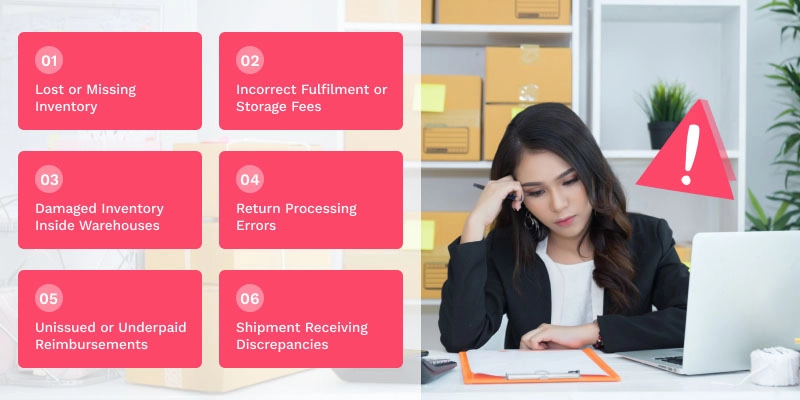
Running your store through Walmart Fulfilment Services can feel like you’ve unlocked a cheat code for e-commerce growth. Orders ship faster, customers trust your listings more, and logistics headaches disappear. But here’s something most sellers don’t realise until they dig into their backend reports: even efficient systems like Walmart WFS aren’t completely error-proof.
Small operational discrepancies are possible since fulfilment systems manage thousands of orders and inventory movements on a daily basis. Unless you actively seek them out, they are typically overlooked when they do arrive. Rather than catastrophic system failures, these are small, routine problems that, if left unchecked, steadily lower your profitability.
Let’s break down the most common ones.
- Lost or Missing Inventory
One of the most frequent issues sellers face is inventory that never shows up in available stock after being shipped to the warehouse. You might send 500 units, but only 492 get recorded as received. The missing units could be misplaced during processing, scanning, or storage. Without monitoring shipment reconciliation reports, those missing units might never be flagged, meaning you absorb the loss unless you file a claim.
- Incorrect Fulfilment or Storage Fees
Fulfilment fees are calculated based on product size, weight, and category. If any of those data points are entered incorrectly or misclassified in the system, you may be charged higher fees than expected. Over time, even small fee discrepancies can add up significantly, especially for high-volume sellers using WFS Walmart.
- Damaged Inventory Inside Warehouses
Products can sometimes get damaged during storage or handling inside fulfilment centres. When this happens, the item becomes unsellable. If the system doesn’t automatically reimburse you or if the reimbursement amount is incorrect, you lose money unless you review the report and submit a request.
- Return Processing Errors
Returns are one of the most complex parts of e-commerce logistics. Occasionally, returned products may:
- Be marked as unsellable when they’re actually fine
- Never get added back to inventory
- Be refunded to customers without being physically returned
- Each of these situations directly impacts your profit margin.
- Unissued or Underpaid Reimbursements
Not all eligible reimbursements are automatically processed. Some require manual claims within a specific timeframe. If sellers don’t review their account data regularly, they may miss reimbursement windows entirely. This is why many businesses use a Walmart seller reimbursement service to track discrepancies continuously and submit claims on time.
- Shipment Receiving Discrepancies
When inventory arrives at a fulfilment centre, it must be scanned and logged. If quantities are recorded incorrectly during receiving, your stock count may be lower than what you actually shipped. Without verification, sellers may never realise the difference.
What Types of Reimbursements Can Sellers Claim?
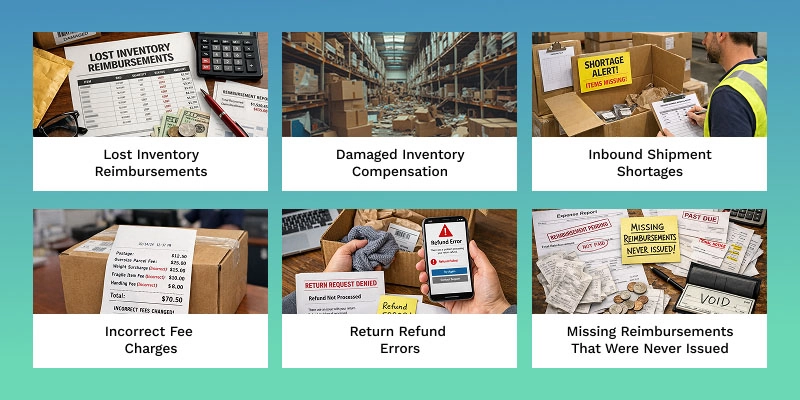
Selling through Walmart Fulfilment Services already familiarises you with the platform’s logistics, including storage, delivery, and returns. But what many sellers don’t realise is that when something goes wrong inside the system, you may be eligible to get your money back. Yes, not every loss has to stay a loss.
Understanding reimbursement categories is one of the smartest things you can do as a seller.
Why?
Because once you know what qualifies, you’ll start spotting opportunities that most sellers overlook. And that’s exactly how experienced sellers recover revenue that others never even notice.
- Lost Inventory Reimbursements
Sometimes inventory gets misplaced or lost after it arrives at a fulfilment centre. This can happen during receiving, storage, or internal transfers. If the system confirms that units are missing and can’t be located, sellers may be eligible for reimbursement based on the product’s value. This is one of the most frequent claim categories and a major reason many brands use a Walmart seller reimbursement service to monitor inventory discrepancies automatically.
- Damaged Inventory Compensation
Products can occasionally get damaged while stored or handled inside fulfilment facilities. Sellers can be eligible for payment if goods turn unusable as a result of warehouse management. But since the reimbursement is not always sent automatically, regular review of papers is crucial.
- Inbound Shipment Shortages
Walmart records the quantity received when you ship inventory to a fulfilment center. A receiving error may be indicated if fewer units are reported than you actually sent. If shipment records verify the disparity, sellers may file claims for these shortfalls.
- Incorrect Fee Charges
Product classification, weight, and dimensions are used to determine fulfilment fees. You can be charged more than you should if your item is wrongly measured or categorised. These inaccurate charges have the potential to gradually lower your margins. Refunds or account credits may follow their identification and correction.
- Return Refund Errors
Returns are complex, and sometimes customers receive refunds without sending the product back, or they return a different or damaged item. In cases where policies allow reimbursement, sellers can file claims to recover losses caused by incorrect return handling within the WFS Walmart system.
- Missing Reimbursements That Were Never Issued
Not all eligible reimbursements are automatically credited to your account. Some require sellers to identify the issue and submit a claim within a specific timeframe. If you don’t check your reports, you may never know you were eligible in the first place.
How to Identify Hidden Profit Leaks in Your WFS Account?
Let’s be honest, most sellers log into their dashboard, check sales, maybe glance at payouts, and log out. If revenue looks good, everything must be fine… right?
Not always.
When you’re using Walmart Fulfilment Services, your business runs on automation. Without your involvement, orders are processed, refunds are managed, and costs are computed. But that convenience can create blind spots. Hidden profit leaks don’t show up as big red warnings. They hide inside reports, transaction logs, and inventory adjustments.
The good news? Once you know where to look, they’re not that hard to find.
- Reconcile Your Inbound Shipments
Compare what Walmart got to what you sent. The quantities received are scanned and logged by Walmart WFS warehouse when you ship inventory to a fulfilment centre. That eight-unit difference is a possible loss if you sent 300 units and only 292 were logged. Cross-check your shipping papers and carrier confirmations against downloaded shipment reports. Hidden losses are most frequently caused by little variations here.
- Review Inventory Adjustment Reports
Inventory adjustments happen when stock is marked lost, damaged, or otherwise unsellable inside the warehouse. These changes directly affect your available inventory and future revenue.
Look for patterns:
- Frequent “damaged” status updates
- Inventory that disappears without a clear explanation
- If adjustments don’t align with expected movement, it may be time to investigate further.
- Audit Fulfilment and Storage Fees
Fulfilment fees are calculated based on product size tier, weight, and category. If your product is mismeasured or misclassified in the system, you could be paying higher fees than necessary.
Compare:
- Your product dimensions and weight
- The fee tier assigned by the system
- Actual charges in your settlement report
Over time, even a small overcharge per unit can significantly impact margins, especially for high-volume sellers operating under WFS Walmart.
- Monitor Return and Refund Data
One of the main causes of misunderstandings in online shopping is returns. When customers return products, you need to confirm:
- Was the item actually received back?
- Was it restocked as sellable inventory?
- Was the refund processed correctly?
If refunds are issued without proper return confirmation, that’s a direct profit leak. Regularly reviewing return reports helps catch these situations early.
- Check for Missing Reimbursements
Not all reimbursements are issued automatically. Some require you to identify the issue and submit a claim within a specific timeframe.
Go through:
If you see qualifying situations without reimbursement records, you may need to take action. This is why many growing brands work with a Walmart seller reimbursement service to track deadlines and claims efficiently.
- Compare Expected vs. Actual Margins
Here’s a simple but powerful trick: calculate your expected profit per unit and compare it with your actual payout. If your numbers don’t match and there’s no change in ad spend or product cost, hidden fulfilment discrepancies might be the reason.
Modern sellers, especially Gen Z entrepreneurs who love analytics, already track conversion rates and ROAS. Adding fulfilment reconciliation to your routine just completes the financial picture.
- Look for Patterns, Not Just One-Off Errors
A single discrepancy may not seem alarming. But repeated small issues often indicate a systematic problem.
Ask yourself:
- Are certain SKUs frequently showing inventory adjustments?
- Do specific products always have higher-than-expected fees?
- Are return-related discrepancies happening more often than usual?
- Patterns reveal where your profit might be slipping away consistently.
What are the Step-by-Step Process of a Smart WFS Audit?
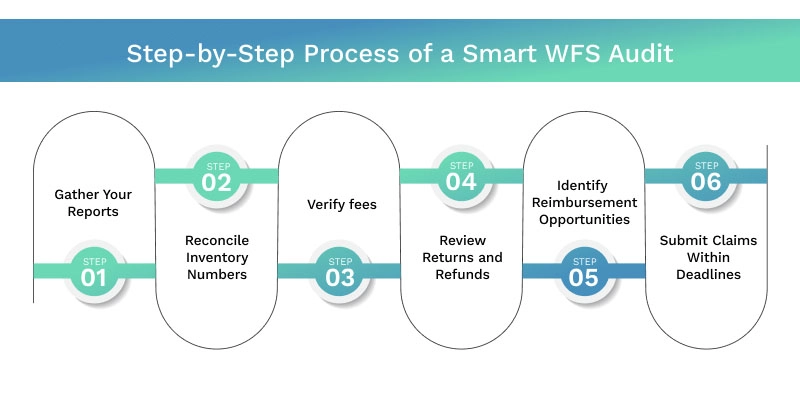
Although it may sound technological, a smart audit is only a methodical method of verifying if your figures match what really happened inside Walmart Fulfilment Services. Imagine it like going over your bank statement; you are essentially verifying that every transaction is correct and noting anything missed. Typically, a good Walmart WFS audit runs:
Step 1: Gather Your Reports
Begin by getting important reports from your seller dashboard, including inventory, payments, returns, and settlement information. The raw material of your audit is these records; they provide an exact picture of how money moved and goods were transported.
Step 2: Reconcile Inventory Numbers
Contrast what was delivered with what was left in inventory. Any discrepancy could point to lost, damaged, or misplaced products inside the WFS Walmart system.
Step 3: Verify fees
Contrast fulfilment, storage, and handling costs with your product needs. You might be paying more if the weight or dimensions were input incorrectly.
Step 4: Review Returns and Refunds
Look at return records carefully. Confirm that refunded orders actually came back and were restocked when eligible. Return discrepancies are one of the most common profit leaks.
Step 5: Identify Reimbursement Opportunities
Flag any case involving missing inventory, damaged stock, or incorrect charges. These may qualify for reimbursement. Many sellers use a Walmart seller reimbursement service at this stage to automatically detect eligible claims.
Step 6: Submit Claims Within Deadlines
If differences satisfy the criteria, submit reimbursement claims before the platform’s claim period finishes. Timing is everything; postponing too long risks losing opportunities to recoup funds.
Here are the key reports every seller should monitor:
- Inventory Adjustment Report – Displays any modifications to your stock, including pieces that have been lost, damaged, or found.
- Received Inventory Report – Confirms quantities Amazon received compared to what you shipped.
- Removal Order Report – Tracks items removed or disposed of from fulfilment centres.
- Reimbursement Report – Lists reimbursements Amazon has already issued (so you can verify accuracy).
- Returns Report – Displays return activity, including refunds and replacement cases.
Regular auditing is vital since claims for payment have to be filed within particular time frames. Your odds of successfully filing a claim and recovering money rise with the early identification of conflicts. Sellers who regularly examine these reports keep ahead of mistakes instead of finding losses many months later.
What are the Warning Signs You Need a WFS Audit Immediately?
Most sellers don’t realise they need an audit until they’ve already lost money. That’s because profit leaks in Walmart Fulfilment Services rarely show up as obvious problems. They don’t send alerts or notifications. Instead, they appear as small inconsistencies that are easy to ignore, unless you know what to watch for.
If you’ve ever felt like your profits should be higher than they actually are, your account might be trying to tell you something. Here are the clearest warning signs that it’s time to run a smart Walmart WFS audit right away.
- Your ProfitsDon’tMatch Your Sales
You’re making steady sales, traffic looks good, conversions are solid… but your payouts feel lower than expected. This is often the first red flag. When revenue and profit don’t align, hidden discrepancies in fees, inventory, or reimbursements could be the cause.
- Inventory Counts Look Off
If your stock numbers don’t match what you shipped, that’s a signal worth investigating. Even small differences may indicate lost or miscounted units inside the WFS Walmart system. Over time, these gaps can quietly reduce your available inventory and your earnings.
- Fees Seem Higher Than Usual
Fulfilment and storage fees should be predictable. If they suddenly increase without any change in product size, weight, or category, something may be misclassified. Incorrect fee tiers can slowly eat into your margins without you realising it.
- Unexpected Refunds or Returns
Seeing refunds you don’t recognise is another strong sign. Sometimes customers receive refunds even when items weren’t returned properly. Without reviewing return reports, you may never know which refunds were valid and which weren’t.
- YouHaven’tChecked Backend Reports in Months
This might sound simple, but it’s one of the biggest indicators. Many sellers focus only on front-end metrics like sales and reviews while ignoring backend operational data. If you haven’t reviewed your reports recently, there’s a high chance you’ve missed discrepancies. That’s why scaling brands often use a Walmart seller reimbursement service it continuously monitors accounts so issues don’t go unnoticed.
- Margins Are Slowly Shrinking
When profits decline gradually instead of suddenly, sellers often blame ads, competition, or pricing. But sometimes the real reason is hidden operational losses inside fulfilment processes. Without auditing, these slow leaks can continue for months.
The following are a few of the most often needed documents:
- Supplier invoices: must clearly display the supplier’s business name and product details
- Cost breakdowns: showing manufacturing or sourcing costs per unit
- Proof of ownership: such as purchase records or order confirmations
- Shipping confirmations: including tracking IDs and delivery verification
Among these, invoices play a particularly important role because they validate the product’s cost and establish the monetary value tied to the claim. Amazon may calculate the cost without them, resulting in a lower refund amount.
The review process will go more quickly and smoothly if documents are arranged, corrected, and made easily accessible. Keeping correct records facilitates vendor approval and expedites reimbursements with fewer holdups
How ValueBack.ai Helps Sellers Recover Lost Revenue?
Selling through WFS can feel like a win: fast shipping, better visibility, and happier customers. But here’s the catch: hidden errors inside fulfilment reports can quietly eat into your profits. That’s where smart auditing steps in, and this is exactly where ValueBack.ai makes a real difference for sellers using Walmart fulfilment services.
It Finds Money You Didn’t Know You Lost
Most sellers don’t realise how often fulfilment discrepancies happen. Missing inventory, incorrect fees, damaged returns, or lost shipments can all lead to revenue leakage. ValueBack.ai automatically scans your Walmart WFS data to detect these issues no spreadsheets or manual digging required. It works like a financial detective that checks every transaction line by line.
Automated WFS Audit = Zero Guesswork
The platform performs an intelligent Walmart seller reimbursement service audit in the background, rather than spending many hours reviewing papers. It points out fulfilment mistakes, flags reimbursement possibilities, and clearly indicates where money is due to you. This automation guarantees nothing falls through the cracks, even as your store grows.
Data-Driven Claims That Actually Get Approved
Filing claims by hand might be difficult and time-consuming. With actual fulfilment data, ValueBack.ai generates precise, evidence-based reimbursement claims. This lowers back-and-forth with support teams and raises approval rates. Simply speaking, quicker payouts come from more powerful claims.
Built for Growth-Focused Sellers
Gen Z entrepreneurs and modern eCommerce brands don’t want complicated dashboards; they want clear insights and quick action. ValueBack.ai presents recovery opportunities in a simple, visual format so you instantly know:
- How much money is recoverable
- Which WFS Walmart transactions caused a loss
- What action is being taken
- That means less stress and more focus on scaling your store
Overlooking Walmart WFS revenue leaks?
Smart audit recovers lost profits.
In today’s competitive eCommerce world, every rupee counts, and every unnoticed error can quietly drain your profits. That’s why a smart audit for your WFS operations isn’t just helpful; it’s essential. Often assuming the system is perfect, vendors utilising Walmart fulfilment services often find that minor differences in inventory, charges, or returns may mount quickly. You might be missing out on reimbursements you legitimately deserve if you don’t monitor yourself frequently.
This is where a reliable Walmart seller reimbursement service becomes a game-changer. Instead of manually checking reports or guessing where losses occurred, tools like ValueBack.ai simplify the entire process. They analyse your Walmart WFS data, identify inconsistencies, and help recover funds, all while you focus on growing your store, launching products, or scaling campaigns.
For Gen Z entrepreneurs and modern sellers who value speed, clarity, and smart automation, auditing isn’t just a backend task; it’s a profit strategy. The truth is simple: ignoring WFS Walmart audits is like leaving money on the table. But when you use a smart system to track, verify, and claim reimbursements, you turn hidden losses into visible gains.
Bottom line: a proactive audit approach doesn’t just protect your revenue, it strengthens your entire selling operation. And in a marketplace where margins matter more than ever, that extra financial edge can be the difference between surviving and scaling.
- What is a Walmart WFS audit?
A Walmart WFS audit is a detailed review of your Walmart fulfilment services reports, including inventory, returns, fees, and settlements. It helps sellers identify discrepancies such as lost inventory, incorrect fulfilment charges, or missing reimbursements. The goal is to ensure your account data matches actual transactions and that you are not losing revenue due to operational errors.
- Why do sellers need a Walmart seller reimbursement service?
Managing audits manually can be time-consuming and complex, especially as order volume increases. A Walmart seller reimbursement service monitors your account for eligible claims, identifies discrepancies, and helps submit reimbursement requests correctly. This increases the chances of recovering funds that might otherwise go unnoticed.
- What types of errors are common in Walmart WFS?
Common issues within Walmart WFS include:
- Missing or misplaced inventory
- Incorrect weight or dimension-based fee charges
- Damaged goods not properly reimbursed
- Refunds issued without returned items
If not reviewed regularly, these errors can slowly reduce your profit margins.
- How often should I audit my WFS Walmart account?
Ideally, sellers should review their reports monthly. High-volume sellers may benefit from continuous monitoring. Regular audits help detect discrepancies within the allowed claim window, ensuring you don’t miss reimbursement deadlines.
- How does auditing improve long-term profitability?
Auditing protects your margins by identifying and recovering lost revenue. Instead of focusing only on increasing sales, a smart Walmart WFS audit ensures you keep more of what you earn. Over time, consistent monitoring strengthens cash flow, improves operational accuracy, and supports sustainable growth.