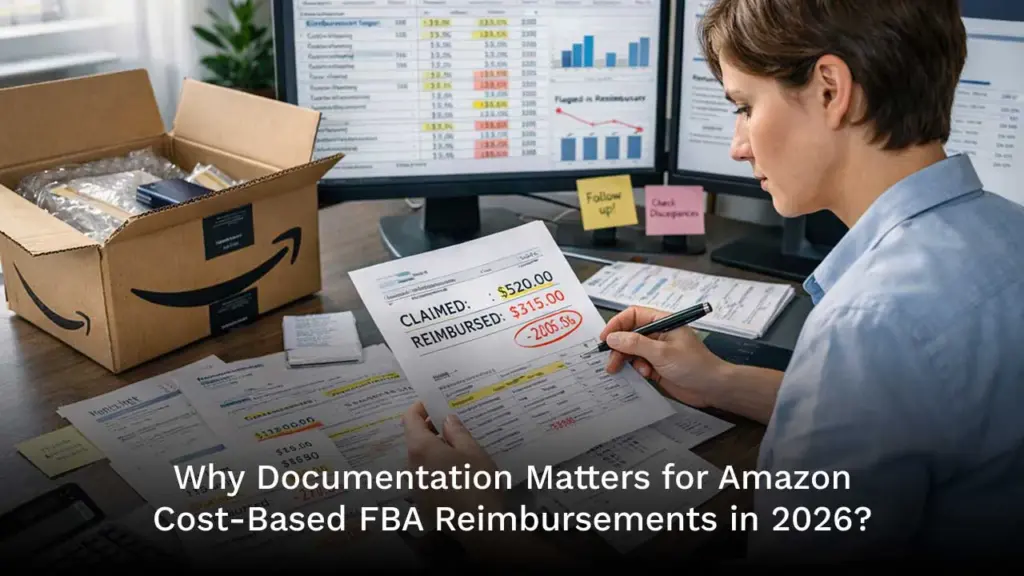
Though selling via Fulfilment by Amazon (FBA) provides worldwide reach and convenience, it also carries operating dangers. Amazon’s fulfilment system periodically experiences inventory loss, damage, or disappearance. When this occurs, Amazon pays its suppliers.
The laws governing these compensations, meanwhile, have drastically altered. Starting in 2025 and running till 2026, Amazon instituted a cost-based pay system whereby vendors get paid according to their actual production or sourcing expenses rather than on the retail worth of the product.
This change has made documentation among the most crucial components of timely reimbursement claim submission. Without accurate proof of costs, sellers may receive reduced reimbursements or have their claims rejected entirely.
In this article, we’ll explain why documentation is critical for Amazon FBA reimbursements which is cost-based in 2026 and how sellers can manage it effectively.
Tired of denied FBA reimbursement claims?
Expert docs unlock your refunds.
What Changed in Amazon’s FBA Reimbursement Policy in 2026?
If you sell on Amazon using FBA, it’s worth understanding how the platform compensates you when your inventory gets lost or damaged in their fulfilment network, because the rules changed in 2025, and not in sellers’ favour.
The old system was fairly generous. Examining your average selling price, comparable goods, and your sales past would help Amazon determine what your product is worth. This often indicates reimbursements are practically close to the price you would have sold the goods for.
That is not true anymore. Amazon now calculates reimbursements depending on your sourcing or production expenses, supplier bills, manufacturing costs, etc, rather. Neither your profit margin nor your selling price factor in.
This is a significant distinction for vendors with slim profits or premium pricing based on branding. You could get only a portion of your past entitlement.
The practical takeaway?
Keep your cost documentation tight. If Amazon needs to reimburse you, what you can prove you paid is now what you’ll get.
Why Amazon Switched to Cost-Based Reimbursements?
Under the older reimbursement system, Amazon would typically pay sellers back based on what their product was estimated to sell for. This worked in the sellers’ favour, since a higher sale price meant a larger recovery when inventory went missing or came back damaged.
The way things work now is different. Amazon FBA reimbursement has shifted to calculation based on what it costs the seller to manufacture or source the item in the first place; this is what’s commonly referred to as the cost of goods sold, or COGS.
When figuring out that cost, Amazon takes several things into account:
What it costs to make the product:
- The raw materials and labour that went into producing it
- Packaging and any quality control work done during production
- Other costs that are directly tied to the manufacturing process
That said, not every expense a seller incurs makes it into that calculation. The following are left out:
- Costs associated with getting inventory into Amazon’s network
Since Amazon is now basing reimbursements on what sellers can demonstrate they paid to produce their goods, having clear and well-documented records of those costs has become more important than ever. Sellers who can’t back up their numbers with solid paperwork may find themselves at a disadvantage when filing claims.
What Counts as “Cost” in Amazon’s Reimbursement Model?
Under the cost-based reimbursement model, Amazon considers only certain costs when calculating reimbursements. These include:
- Direct Manufacturing Costs: include those for raw materials and labour that is, the main expenditures related to creating a product.
- Production Expenses: This may include packaging materials, assembly costs, and quality control processes.
- Costs incurred by suppliers: Usually, the product price on a supplier bill for retailers getting goods from manufacturers or merchants is shown.
That is, the reimbursement is based on the cost of creating or buying the product itself, not the price at which it is sold.
What Does Not Count as “Cost” in Amazon’s Reimbursement Model?
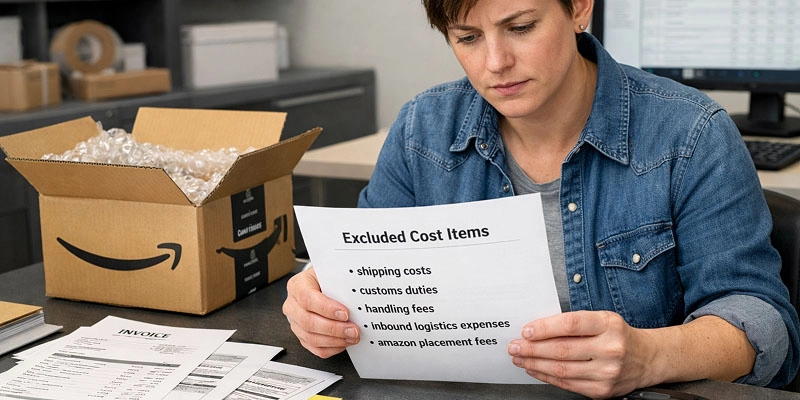
One of the biggest surprises for many sellers is that several expenses are not included in Amazon’s reimbursement calculations. These include:
- Inbound logistics expenses
Amazon omits these costs since checking them for every claim would greatly impede the compensation procedure. This implies that sellers must carefully watch their costs so as to fully understand the true economic impact of damaged or missing items.
Why Has Documentation Become More Important Than Ever?
- It Proves the True Cost of Your Product
Under the cost-based model, Amazon FBA Costs needs evidence of the actual sourcing cost before approving reimbursement. Sellers must provide documents such as:
- Wholesale purchase invoices
- Tax invoices or supplier documentation
These records help Amazon verify the cost associated with a specific product or FNSKU. Without valid documentation, Amazon may estimate the cost automatically. Many times, the estimated cost is considerably less than what it truly is.
- Prevents Underpayment in Reimbursement Claims
When documentation is incomplete or unclear, Amazon may use a default cost estimate. Sellers may eventually get considerably less than the true worth of their missing stock.
For instance, if Amazon FBA seller reimbursements values a seller’s real sourcing at $3, but their refund will be based on the lower amount, $8. Good documentation guarantees that Amazon pays sellers on confirmed information instead of guesses.
- Ensures Faster Claim Approvals
One of the most frequent causes of delayed or denied refund demands is incomplete claims. Amazon requires documents to include important information such as:
- Supplier name and address
- Product details and quantities
- Price and currency information
Faster and more precise Amazon claim processing results from the clear showing of these specifics.
- Helps Maintain Compliance with Amazon Policies
Amazon has tightened claim submission windows for reimbursement cases. Sellers could have as few as 60 days to submit a request following an event, depending on the kind of claim.
Keeping proper documentation enables salespeople to swiftly react when inconsistencies show in their inventory records. Sellers without simple access to papers can miss claim deadlines and miss the chance to recoup their losses.
- Supports Accurate Cost Tracking Across Products
Another important rule in the updated policy is that only one cost can be assigned per FNSKU when submitting sourcing cost data.
Maintaining consistent paperwork becomes absolutely critical if merchants handle many suppliers or production runs. Organised records guarantee that the cost of every item is fairly represented in the reimbursement plan.
What are the Common Documentation Sellers Should Maintain?
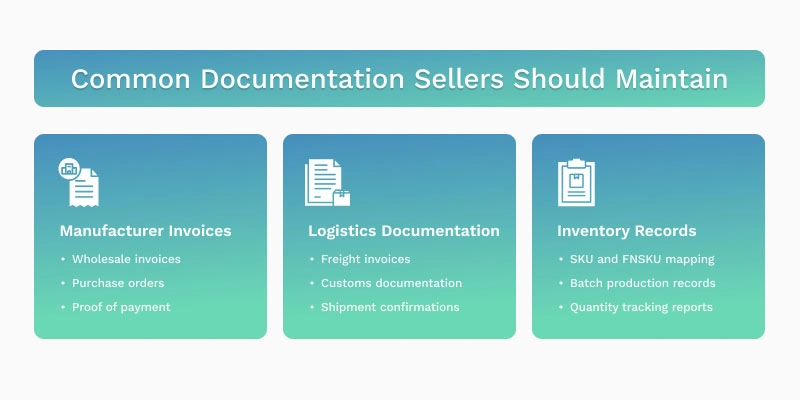
Maintaining consistent paperwork becomes absolutely critical if merchants handle many suppliers or production runs. Organised records guarantee that the cost of every item is fairly represented in the reimbursement plan.
Manufacturer Invoices
Logistics Documentation
Inventory Records
- Quantity tracking reports
Keeping these documents in a centralised system can make claim filing far easier.
What are the Best Practices for Maintaining Documentation for Amazon FBA?
Keeping Your Reimbursement Documentation in Order
Preparing is not only a wise habit if you are using a cost-based compensation model, but it can also directly affect the amount of money you get back if anything goes wrong. Damage shipments, lost inventories, and fulfilment errors occur more often than most vendors understand. Having the correct documents in order will free you from having to hurry when it comes time to submit a claim.
Go paperless with your invoices
Keeping digital or scanned copies of all purchase documents and supplier invoices enables you to promptly get access to them for justification of a reimbursement claim or objection. Using a well-organised cloud folder or document management solution is always less effective than sifting through email threads or physical papers. Every invoice should be available in a matter of seconds rather than minutes.
Get your suppliers into a consistent routine
You may save a lot of later back-and-forth if invoices always include the same SKU, quantity, unit price, and supplier data. Create a basic template or checklist for your vendors if they do not already possess one. Keeping consistency at the source helps you to bypass a great deal of clean-up effort.
Check your inventory reports regularly
Don’t wait for problems to pile up. Reviewing your fulfilment reports on a routine basis makes it much easier to spot discrepancies early whether that’s missing stock, items that arrived damaged, or units that were lost somewhere in the fulfilment chain. The sooner you catch an issue, the stronger your position is when it comes to filing for reimbursement.
Document sourcing costs for every FNSKU
For each product you carry, make sure the sourcing cost is clearly recorded and up to date. This data becomes critical the moment you need to calculate what you’re actually owed. Without verified cost records tied to each FNSKU, you risk receiving lower reimbursements than you’re entitled to or having claims rejected altogether.
Audit your reimbursement reports on a schedule
Claims are incredibly simple to disregard, especially as your stock grows. Reviewing your reimbursements once a month or quarter will help you to spot chances that would otherwise be missed. Treat it like any other financial reconciliation, with a set time on the calendar rather than only paying attention when something appears to be amiss.
How Automation Tools Simplify Reimbursement Documentation?
How Automation Tools Simplify Reimbursement Documentation
One of those jobs that starts simple and quietly turns overwhelming is the hand management of reimbursement paperwork. Tracking every invoice, error, and claim over tens or hundreds of SKUs becomes rather difficult on your own as your inventory expands and order volume rises. Automation tools really come into use there.
Taking the legwork out of data collection
Automation tools, rather than logging into several portals, downloading reports, and manually cross-referencing spreadsheets, connect directly to your seller account and compile everything into one place. Automatically recorded invoices, fulfilment reports, and inventory changes provide you with a real-time view free of the need for manual effort.
Catching discrepancies you might otherwise miss
Even the most careful merchants overlook things. Built to instantly flag inconsistencies, automation tools continually scan your fulfilment records to highlight any gaps that demand attention. Manually recreating this sort of constant surveillance at scale is just not practicable.
Faster, more accurate claim filing
Filing a reimbursement claim entails compiling invoices, shipping records, and cost information in a way the platform will find acceptable. Automation systems help to structure this data in advance and, in many cases, automatically generate claim-ready reports, hence accelerating the process and lowering the risk of inaccuracies that could cause a denied claim.
A cleaner audit trail
Automatically logging every action, update, and submission, automation tools provide a dependable history you may consult anytime. Should a disagreement develop or you need to reexamine a prior claim, that paperwork is already available, well-organised and simple to get at.
FBA cost disputes denied due to docs?
Expert paperwork wins every reimbursement.
Amazon’s move to cost-based FBA reimbursements is one of the most significant adjustments to the marketplace’s seller policies. While the new model seeks to standardise reimbursement calculations, it also increases sellers’ responsibility to keep correct cost data.
Documentation is now essential; it is not optional. Maintaining precise invoices, cost logs, and shipping documentation enables vendors to guarantee just compensation for inventory problems. Strong documentation is a vital technique to sustain sales in the always-changing Amazon selling environment, not just an administrative obligation.
- What is cost-based reimbursement, and how does it affect sellers?
Cost-based reimbursement is a model where sellers are compensated based on the documented sourcing cost of a product rather than its retail price. This means the reimbursement amount you receive for lost, damaged, or missing inventory is tied directly to what you paid for it. If your cost records are incomplete or inaccurate, you risk receiving less than you’re actually owed, which is why keeping verified cost data for every product is so important.
- What documents do I need to support a reimbursement claim?
At a minimum, you’ll typically need supplier invoices, purchase records, and shipping documentation. Each document should clearly show the product SKU, quantity, and unit cost. Having these organised and readily accessible makes the claims process significantly smoother and reduces the chance of a rejection due to missing information.
- How often should I audit my reimbursement reports?
Ideally, you should review your reimbursement reports at least once a month. For sellers with higher order volumes or larger catalogues, more frequent checks, even weekly, can help catch discrepancies before they become harder to trace. Think of it as a routine financial reconciliation rather than something you only do when a problem surfaces.
- Can I manage reimbursement documentation without automation tools?
It’s possible, but it becomes increasingly difficult as your business scales. Manual tracking works for sellers with a small number of SKUs and low order volume, but the chances of missing a claim or making an error grow significantly as complexity increases. Automation tools handle the monitoring and data organisation continuously, giving you far better coverage with far less effort.
- What happens if I miss a reimbursement claim?
Most platforms have a window during which you can file a reimbursement claim, and once that period closes, you generally lose the ability to recover those funds. This is one of the strongest arguments for regular audits and automation; missed claims aren’t just inconvenient, they represent real money left on the table. Staying on top of your reports consistently is the best way to make sure nothing slips through.